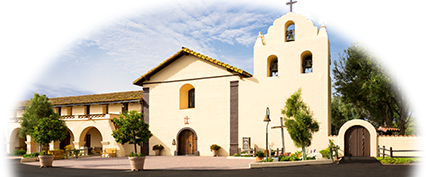

In order to serve the Chumash Indians in the Santa Ynez Valley area and to serve as a link between the Missions in Santa Barbara and Lompoc, the Mission was established in 1804. While still in its formative years, the Mission was devastated by the great earthquake of 1812. The Mission continued to rebuild and repair, and actually became very prosperous during the first part of the 19th century, when the Indian population was at its greatest. The Mission acreage produced plentiful harvests, and its livestock numbered in the thousands. Mission Santa Inés also became linked to one of the earliest Anglo settlers in California.
After Mexican independence from Spain, secularization caused the departure of the Spanish Missionaries and the Indian neophytes, which nearly wiped out the Mission. Despite the fact that the first college seminary in California was temporarily situated at Mission Santa Inés in 1844, it would have fallen into complete ruin were it not for the arrival of the Donahue family in 1882 and Father Alexander Buckler in 1904. Father Buckler began the repair of the Mission building and enlisted the talents of his niece to restore the art and artifacts. The Capuchin Franciscan Friars from Ireland, who followed them in 1924, continued their good works and efforts in this regard.
Today the process continues to restore, preserve, and return the "Mission of the Passes" to its former grandeur of the early Mission era. Mission Santa Inés is the proud and fortunate possessor of a rich collection of paintings, statuary, vestments, manuscripts, and artifacts. The Santa Inés Mission Museum houses a collection of vestments, artwork, documents, and artifacts that were used in and around the Mission throughout its history.
In the following century, Franciscan Missionaries joined the Spanish military in settling alta or upper California with the goal of a political and spiritual conquest of the new land. The Spanish Missionary effort was to educate and convert the Indians to the Christian faith. As historian Maynard Geiger described it, "This was to be a cooperative effort, imperial in origin, protective in purpose, but primarily spiritual in execution."
The Chumash populated a wide area - from Santa Paula to San Luis Obispo. They had a diversified and interdependent economy based on their many talents and craftsmanship. The Chumash even developed an excellent astronomical system, which was on a par with Europe in terms of accuracy. Their small, well-organized villages, called rancherias by the Spanish-speaking settlers, were made up of many large huts built from poles interwoven with reeds. The Indians gathered and leached acorns, and they also harvested nuts, seeds, and berries. They were skilled fishermen and enjoyed a variety of sea food, and they hunted animals as well. Al though their only tool was flint, the resourceful Chumash created remarkably well-constructed sea-going plank canoes.
The founding of a Mission between La Purisima and Santa Barbara had been on the minds of the Missionary fathers for several years. An inland Mission north of Santa Barbara would solidify their work in the area; they would be able to take advantage of the Chumash Indians' already favorable disposition to being converted to Christianity - In addition, a very militant Indian tribe, the Tulares, lay to the northeast, just beyond the region controlled by the peaceful Chumash. A Mission in the Santa Ynez Valley would secure the region as a buffer zone.
After completing the initial chain of Missions to the north, Father Lasuen directed Father Estevan Tapis of Mission Santa Barbara to accompany Captain Felipe de Goycoechea to survey possible Mission sites northeast of the coastal mountains. In the fall of 1798 the expedition surveyed the Calahuasa rancheria (presently the Santa Ynez Indian Reservation) and another Chumash site called Alajulapu (presently Solvang). Father Tapis reported that there were 325 dwellings at 14 sites at Calahuasa, so Lasuen requested Governor Diego Borica to recommend Calahuasa as a suitable site for a new Mission.
It would be a number of years before the Franciscans were able to launch their new Mission. The governor died, so approval was then needed from his successor, Jose de Arrillaga, in Baja California. Unfamiliar with the area, Governor Arrillaga wrote to Father Lasuen in April 1803 concerning the number of guards that would be needed for the new Mission, but then Father Lasuen died.
In June of 1803 the new President of the Missions, Father Tapis, responded to Arrillaga's letter, detailing the number of Indians in the area and significant events such as the small group of Indian outlaws who had been committing murders throughout the region. In September the Father Guardian of the Franciscan order came from Mexico to survey the site and determined that a guard of six men would be sufficient to protect the Mission.
On September 17, 1804 Father Tapis officially dedicated the Mission to Saint Agnes. A temporary brushwood shelter was constructed at which 200 Indians attended solemn High Mass. Twenty-seven children were baptized and fifteen men enlisted for instruction. Fathers José Rumualdo Gutiérrez and José Antonio Calzada were selected as the first resident priests, and by the end of 1804 the Baptismal Register already contained the names of 112 Indian converts of all ages.
The cemetery is located behind the Mission bell-tower. The first entry in the burial register is dated January 23, 1805. |
Although it was the last of the Southern California Missions, Mission Santa Inés was growing quickly because it could draw upon the support, tradition, and experience of the older, established Missions. In 1807 new dwellings were constructed for the Missionaries, and five double homes were built in 1810 for soldiers and their families, plus a storehouse and guardhouse.
Changes in the political air were soon to have their effect on Mission life. After the beginning of the Mexican War of Independence against Spain in 1810, support from Spain was no longer available to the Missions, which meant their activities had to be self-supporting. Furthermore, soldiers were not receiving their wages and supplies regularly. This pushed the presidio commanders to become increasingly, if not unreasonably, dependent on the Missions. The Missions were to supply food and clothing to the soldiers, for which they were given IOU receipts.
For safety, a temporary church was erected outside the quadrangle area. Reconstruction of the damaged buildings continued over the next four years, and a new and larger church facing east was built of adobe and brick. It measured 140 feet long, 25 feet wide, and 30 feet high, with heavily buttressed walls 5 feet thick. Heavy pine timbers brought from the San Rafael Mountains supported its ceiling and re-tiled roof The ceiling height was lowered on the residence of the friars, and the flat roof was replaced with a gabled roof covered with tiles. These buildings, which were dedicated on July 4, 1817, are all that remain today of the Mission from that era.
The lavenderia (laundry), where Indian women washed their clothes, is preserved today on the Mission grounds. |
From 1808 until 1824, Father Uria continually pushed an ambitious building program. In the initial years of the Mission, he oversaw the development of housing for the Missionaries and soldiers, as well as the construction of the storehouse. After the earthquake of 1812, he supervised the reconstruction of the church. It was Uria who saw to it that the church interior was decorated with murals between 1818 and 1820. He also directed the construction of the new grist mill and reservoirs in 1820; they were built with massive walls to avoid damage from future earthquakes. In 1824, the church interior was freshly painted and redecorated. During this year, numerous paintings and other church artifacts were acquired that can be seen in the Mission today.
Originally from Maine, Joseph Chapman eventually came to Hawaii in 1818. During this time, the French pirate Hippolyte de Bouchard was sailing against Spain. After raiding the Philippines, he too arrived in Hawaii. Bouchard acquired an additional ship and an unwilling crew, including Joseph Chapman, and sailed for Spanish settlements in California in October 1818. Military and civilians were alerted up and down the coast to watch for the pirates. After a stop in Monterey, Bouchard's group sailed south to Santa Barbara. The pirates found the Ortega Ranch in Refugio Canyon conveniently deserted when they arrived, so they plundered the ranch and set it on fire. Sergeant Carlos Antonio Carrillo and his men lay in wait to ambush Bouchard outside Refugio. Chapman and several others were captured by the squad of soldiers.
Bouchard sailed to Santa Barbara under a flag of truce and asked the Presidio for an exchange of prisoners. In the process, Chapman somehow ended up freed from Bouchard, but was held as a temporary prisoner in the Presidio. Upon his release, he became a model citizen. He was baptized as a Catholic at Mission San Buenaventura and later married Guadalupe Ortega (of the Ortega Ranch) at Mission Santa Inés. Chapman and his wife moved to Santa Ynez, where he was employed at the Mission. In 1821 Chapman constructed the Mission's fulling mill (for treating woolen garments), which was built near the grist mill.
The Missions already were owed thousands of pesos of IOUs from the presidios. Antagonism grew as the soldiers compelled the Mission Indians to work overtime without pay over the objections of the Mission fathers. Ill-tempered and discontented because they themselves were without pay and supplies, many soldiers allowed their frustrations to affect the way they treated the Indians. In 1824 events and emotions were pushed to the boiling point.
A Spanish guard at Santa Inés flogged a Purisima Indian, setting off a revolt that touched all the Santa Barbara area Missions. In the revolt against the Santa Inés soldier guards, two Indians were killed, several buildings were set on fire, and the priests became unwitting hostages with the soldiers' families with whom they took initial refuge. The revolt lasted several months, and before it was over fourteen Chumash lives were lost, including the two at Santa Inés. The Indians rightly feared reprisal from the soldiers and fled from the Missions to hide.
Ultimately, the Indians had no quarrel with the padres, whom they treated with deference and respect. However, the natives made it clear to the padres that the soldiers' attitudes and behavior were the reasons for the uprising. The Chumash felt that since they had worked on behalf of the soldiers without any pay and for an inordinate amount of time, they should have been treated with the utmost kindness, gratitude, and dignity Instead they received arrogant disrespect and derision.
During the revolt, the soldiers had unnecessarily destroyed some of the Indians' homes and possessions. The padres did not condone the actions of the Indians, but were quick to call the behavior of the Presidio personnel unreasonable, and in some cases inexcusable, especially the unjustifiable killings of the Indians.
The problem with this was that in many cases there were no secular personnel or diocesan personnel available to run the Missions. As a "parish church" Mission Santa Inés had no governmental support. The Mission fathers initially maintained themselves from the income gained from the sale of cattle, tallow, hides, and from what grain could be harvested.
The resulting conditions were disheartening for the Indians, who received little or no recompense for their labors and were required to pay the salary of the secular "administrators". The result was that many Chumash simply fled. This aggravated the decline of the Mission system, since there were no longer enough Indians to attend to the crops and cattle and maintain the buildings
The sympathetic Micheltorena was replaced in 1846 by Governor Pio Pico, whose policies accelerated the despoiling of the Missions. In June of 1846 he illegally sold Mission Santa Inés to José M. Covarrubias and José Joaquin Carrillo for $7,000, just three weeks before the United States took control of California.
Fathers J. J. Jimeno and Francisco Sanchez continued in charge of the college seminary until May 7, 1850 when they surrendered the management of Mission Santa Inés to priests of the Congregation of the Sacred Hearts of Jesus and Mary (Picpus Fathers of South America). The arrival and brief stay of the Picpus Fathers at Mission Santa Inés marked the end of Franciscan management and the Mission period.
In 1851 the United States government rescinded the illegal sale of the Mission lands by Pio Pico. A decree signed by President Lincoln on May 23,1862 formally returned the Missions to the Catholic Church, with possession given to the Bishop of Monterey, since the Franciscans were no longer at the Mission.
![]() |
This photo of ruins at Mission Santa Inés
may date from as early as 1865. SANTA BARBARA MISSION ARCHIVE-LIBRARY |
In 1882 the Donahue family came from Ireland to live at the Mission. For 16 years they resided in the southern half of the rectory and, despite a lack of funds, set themselves to the task of making repairs and re-roofing. However, the scope of repairing the quickly deteriorating structures was beyond any one family. The southern section of the front corridor collapsed in 1884, and soon the adjacent building fell into ruin, leaving only the buttressed arch, currently preserved within the parking area.
Father Alexander Buckler SANTA INÉS MISSION ARCHIVE. |
He began a concerted effort to maintain and restore the Mission buildings and their contents. Besides addressing the basic needs of better shelter; he constructed a water and drainage system and reinforced much of the padres' crumbling quarters. Father Buckler had the church and parts of the rectory re-roofed and removed the crumbling adobes at the rear. During an exceptionally heavy rainstorm in 1911, the bell tower; already weakened from age, collapsed. The following year Father Buckler rebuilt it and added a third arch.
Among the most cherished possessions of the Mission are the vestments. Father Buckler sought the assistance of his niece, Miss Mamie Goulet, to repair the vestments, as well as some of the paintings and statuary.
When Father Buckler retired in November 1924, an offer was made to return Mission Santa Inés to the Franciscans. The Franciscan superior declined to accept, so the offer was extended to the Capuchin Franciscan Order of the Irish Province.
| The expansive garden behind the Mission is a lovely surprise for many visitors. Dating to the Mission's earliest days, the garden has undergone many changes; it currently retains the formal design of a hedge in the shape of a Celtic cross implemented by the Capuchin Franciscans in 1926. |
![]() |
Fathers Kelleher and O'Leary examine adobe walls during renovation work in 1949. SANTA INÉS MISSION ARCHIVE. |
The Chapel of the Madonna was created during this period and numerous restoration projects were initiated. A radiation heating system was installed in the church under the original restored tile floor to preserve the Mission's priceless paintings and other artwork by moderating the damp conditions. The entire Mission was painted and weatherproofed. Improved irrigation and drainage systems were installed for the various refurbished and re-landscaped gardens. In 1954 a statue of Our Lady of Lourdes made in Obergammergau was installed in the shrine next to the cemetery.
Foundation stones of the original Mission quadrangle may still be found at the northwest corner of the Mission grounds. The original quadrangle, which measured 350 feet square with walls 20 feet high, contained all that was necessary for the Mission at that time: a tannery, blacksmith and potter's shops, facilities for weaving and basket making, a soap factory, and other work areas. Two new bronze bells named "Santa Inés" and "Saint Francis" were cast and installed in the bell tower in 1984.
The restored arched colonnade with ruin of the original 19th arch. |
Many early-era architectural details, such as this beautiful door handle, can be appreciated at today's Mission. |
Community groups are allowed to use Mission facilities for public functions such as the annual Story Telling Festival and the yearly Rancheros Vistadores horse-riding event, and the Mission grounds are used as the staging area for parades and cycling events. The popular annual Fiesta benefits restoration work at the historic Mission.
Mission Santa Inés continues as an active parish church of approximately 1,000 families. It holds regular religious services as well as special services for baptisms, confirmations, weddings, and funerals. The Mission staff conducts religious education classes, youth groups, and various programs for adults.
Visitors are always welcome. A taped audio tour is available in our gift shop to guide visitors through the Museum rooms, church, and garden.